7. Any time you are asked to find the minimum work, assume the work is done at equilibrium. Thus the force required to push the cart up the incline in (a) is mg sin(theta). The work is therefore mg*sin(17.5)*300m*(1) = 884,000 J
b) Again, using sigma_Fx = 0, the force required to do this is (mg*sin(17.5) + mu*mg*cos(17.5))* 300 m = 1,600,000 J.
13. The work done by the force is the area under the curve for the given start and end positions.
a) Work = .5*(400 N)*(10 m + 4 m) = 2,800 J
b) Work done from x = 10 to 15 m is NEGATIVE (since it is in the negative direction), so the total work will be 2,800 J - .5*(200 N)*(5 m + 2 m) = 2,100 J
18.
a) If the KE is doubled, the speed is multiplied by the square root of 2.
b) if the speed is doubled, the KE is multiplied by 4.
22. v = (2*Fnet*delta_x/m)^(1/2) = 43.59 m/s
23. Fnet = mv^2/(2*delta_x) = 343 N
25. Through a free body diagram, you should obtain that Fnet = mu*mg. Using this and the work-energy theorem:
mu*mg*delta_x*(-1) = 0 - .5*m*v0^2
Solving:
v0 = (2*mu*g*delta_x)^(1/2) = 26.91 m/s
28.
a) This is a Newton's 2nd problem! T = mg + ma = 2479 N
b) Wnet = Fnet*delta_x*(1) = m*a*delta_x = 6791 J
c) WT = T*delta_x*(1) = 52,059 J
d) Wg = mg*delta_x*(-1) = -45,276 J
e) Wnet = .5*m*vf2 - 0
So vf = (2*Wnet/m)^(1/2) = 7.852 m/s
Monday, October 27, 2008

Friday, October 24, 2008
Really? You Thought We had no HW?
I wrote this on the board before we started talking about the lab, but yes, we DO have a homework assignment for the weekend!
Chapter 6 - pages 172-179, Question 2 and 3, Problems 1,2,4,5,6, and 8.
Enjoy! Solutions to the HW and quiz will be posted later.
UPDATE:
Quiz solutions are posted here.
Solutions:
1. In this problem, assume the normal force is doing the work in equilibrium, so Fn - mg = 0, so Fn = mg. The work is therefore mg*delta_x* cos(1) = 7350 J
2.
a) Constant speed, so F - Fk = 0. The work done by F = (180 N)(6 m)(1) = 1080 J
b) Again constant speed, so F = mg. W = mg*delta_x*1 = 5400 J
4. The retarding (friction) force does negative work, preventing the car from speeding up. The work done by friction is negative since if the car moves to the right, friction is directed to the left. Thus the only unknown in the equation is the magnitude of the force. F = -70,000J/(2800m*(-1)) = 25 N
5. The only force acting on the rock is gravity. You know how much work is done on it, so the only unknown is the displacement. delta_x = W/mg = 36.1 meters. The signs of the work require a bit more explanation than will make sense here - we can talk more about it in class.
6. The maximum work is what would happen if all of the work done by gravity during the fall went into the nail. This means you have to find the work done by gravity as it falls. This is mg*delta_x*(1) = 7.84 J. This is not very much work! This is why it pays off to exert a bit more force when you are hammering, rather than let gravity do all the work.
7. Any time you are asked to find the minimum work, assume the work is done at equilibrium. Thus the force required to push the cart up the incline in (a) is mg sin(theta). The work is therefore mg*sin(17.5)*300m*(1) = 884,000 J
b) Again, using sigma_Fx = 0, the force required to do this is (mg*sin(17.5) + mu*mg*cos(17.5))* 300 m = 1,600,000 J.
8. Normal force and gravity do no work since they are perpendicular to the horizontal displacement. Since the cart travels at constant speed, the sum of the forces in both directions is zero.
F cos(20) - Fk = 0 so Fk = F cos(20).
The work done by F is F cos(20)* 15 m *(+1) = 169.1 J.
The work done by Fk = F cos(20)* 15 m * cos(180) = -169.1 J.
Chapter 6 - pages 172-179, Question 2 and 3, Problems 1,2,4,5,6, and 8.
Enjoy! Solutions to the HW and quiz will be posted later.
UPDATE:
Quiz solutions are posted here.
Solutions:
1. In this problem, assume the normal force is doing the work in equilibrium, so Fn - mg = 0, so Fn = mg. The work is therefore mg*delta_x* cos(1) = 7350 J
2.
a) Constant speed, so F - Fk = 0. The work done by F = (180 N)(6 m)(1) = 1080 J
b) Again constant speed, so F = mg. W = mg*delta_x*1 = 5400 J
4. The retarding (friction) force does negative work, preventing the car from speeding up. The work done by friction is negative since if the car moves to the right, friction is directed to the left. Thus the only unknown in the equation is the magnitude of the force. F = -70,000J/(2800m*(-1)) = 25 N
5. The only force acting on the rock is gravity. You know how much work is done on it, so the only unknown is the displacement. delta_x = W/mg = 36.1 meters. The signs of the work require a bit more explanation than will make sense here - we can talk more about it in class.
6. The maximum work is what would happen if all of the work done by gravity during the fall went into the nail. This means you have to find the work done by gravity as it falls. This is mg*delta_x*(1) = 7.84 J. This is not very much work! This is why it pays off to exert a bit more force when you are hammering, rather than let gravity do all the work.
7. Any time you are asked to find the minimum work, assume the work is done at equilibrium. Thus the force required to push the cart up the incline in (a) is mg sin(theta). The work is therefore mg*sin(17.5)*300m*(1) = 884,000 J
b) Again, using sigma_Fx = 0, the force required to do this is (mg*sin(17.5) + mu*mg*cos(17.5))* 300 m = 1,600,000 J.
8. Normal force and gravity do no work since they are perpendicular to the horizontal displacement. Since the cart travels at constant speed, the sum of the forces in both directions is zero.
F cos(20) - Fk = 0 so Fk = F cos(20).
The work done by F is F cos(20)* 15 m *(+1) = 169.1 J.
The work done by Fk = F cos(20)* 15 m * cos(180) = -169.1 J.
Wednesday, October 22, 2008
Around the World in 90 Minutes - Orbit and Planetary Motion
Some distractions before you check your answers:
First, a ride to space on the Space Shuttle:
The view out of a shuttle window during orbit:
This site lists opportunities to see the International Space Station fly over New York City.
There is one pass tomorrow (Thursday) at 6:23 AM, starting in the south at 11 degrees above the horizon, and ending in the East at 35 degrees above the horizon 3 minutes later. It will peak at almost 45 degrees above the horizon halfway through. You will be looking for a fast moving "star", though this "star" is actually a spacecraft housing two Russian and one America astronauts!
Solutions to Orbit Problems from today:
1. The mass of the Earth as determined from this problem is 5.98 x 1024 kg
2. Since the mass of the orbiting satellite divides out from both sides of the equation, it is not possible to determine the mass of a satellite just from knowing its orbital speed and altitude. The government was concerned about what sort of weapon the Russians might be able to load onto such a satellite that passed over the entire world. This kicked off another chain of events that ultimately led to the US developing its own space program.
3. This problem again asks you to derive an expression for the speed of an orbiting satellite. You should obtain that v = (GMe/R)^1/2 where G is the gravitational constant, Me is the mass of the Earth (see question 1) and R is the radius of the orbit of the satellite. The way to increase the altitude of the satellite involves slowing down (or decreasing the speed) by firing a rocket.
In reality, it isn't quite this simple. What is usually done is there are TWO rocket firings required - a first to change the satellite's speed to get it into a new elliptical orbit that reaches the desired new altitude, and a second that pushes the satellite into a circular orbit at the new altitude. This process is called a Hohmann transfer depicted below.

4. Following the steps from class, the radius of the orbit is twice the radius of Earth. The speed of the satellite is 5,591 m/s, and the period is 239 minutes (14340 seconds).
5. minimum speed is (gR)^1/2 = 14 m/s
6. a = (100N*cos(40) - .32*(196 N - 100 N sin(40))/(20 kg) = 1.723 m/s^2
One last toy to check out: An orbit simulator. Try to put some satellites into orbits, and watch how they move differently in elliptical vs. circular paths.
First, a ride to space on the Space Shuttle:
The view out of a shuttle window during orbit:
This site lists opportunities to see the International Space Station fly over New York City.
There is one pass tomorrow (Thursday) at 6:23 AM, starting in the south at 11 degrees above the horizon, and ending in the East at 35 degrees above the horizon 3 minutes later. It will peak at almost 45 degrees above the horizon halfway through. You will be looking for a fast moving "star", though this "star" is actually a spacecraft housing two Russian and one America astronauts!
Solutions to Orbit Problems from today:
1. The mass of the Earth as determined from this problem is 5.98 x 1024 kg
2. Since the mass of the orbiting satellite divides out from both sides of the equation, it is not possible to determine the mass of a satellite just from knowing its orbital speed and altitude. The government was concerned about what sort of weapon the Russians might be able to load onto such a satellite that passed over the entire world. This kicked off another chain of events that ultimately led to the US developing its own space program.
3. This problem again asks you to derive an expression for the speed of an orbiting satellite. You should obtain that v = (GMe/R)^1/2 where G is the gravitational constant, Me is the mass of the Earth (see question 1) and R is the radius of the orbit of the satellite. The way to increase the altitude of the satellite involves slowing down (or decreasing the speed) by firing a rocket.
In reality, it isn't quite this simple. What is usually done is there are TWO rocket firings required - a first to change the satellite's speed to get it into a new elliptical orbit that reaches the desired new altitude, and a second that pushes the satellite into a circular orbit at the new altitude. This process is called a Hohmann transfer depicted below.
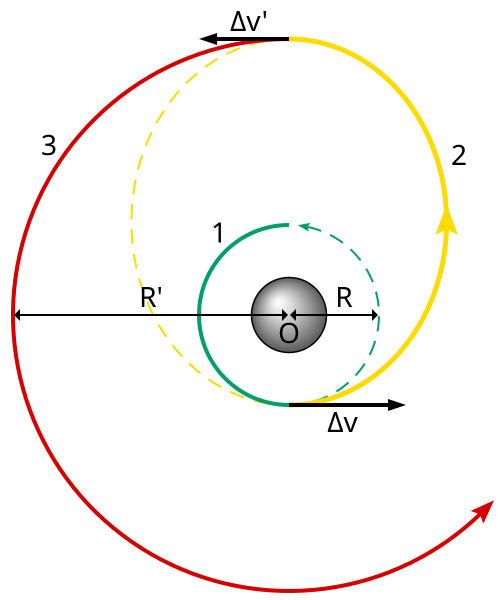
4. Following the steps from class, the radius of the orbit is twice the radius of Earth. The speed of the satellite is 5,591 m/s, and the period is 239 minutes (14340 seconds).
5. minimum speed is (gR)^1/2 = 14 m/s
6. a = (100N*cos(40) - .32*(196 N - 100 N sin(40))/(20 kg) = 1.723 m/s^2
One last toy to check out: An orbit simulator. Try to put some satellites into orbits, and watch how they move differently in elliptical vs. circular paths.
Tuesday, October 21, 2008
The gravity of the situation - Newton's Law of Gravitation
First, a link to a description of the Cavendish experiment that determined the magnitude of the Gravitational constant to be 6.67 x 10⁻¹¹ N*m^2/kg^2.
Homework Solutions:
Questions:
6. The apple exerts a force on the Earth equal to the magnitude of its weight, by Newton's Third Law. This is independent of whether the apple is falling or sitting still. Newton's law of gravitation applies whenever you have two objects with mass, regardless of what they are actually doing.
7. The acceleration due to gravity would be greater since g = GMp/R^2. If the distance was the same (and the orbit was still circular) this would mean that the moon would have a greater speed as it orbits, so it would change phases from new to full more quickly.
16. The question is better answered by saying the gravity force keeps the satellite "down" in its orbit, as it keeps the satellite moving in a circular path. Without the gravity force, satellites would travel in straight line paths.
Problems:
26. using g = GM/r^2, the acceleration is 1.619 m/s^2
30. Calculate the acceleration due to gravity to show the strength of the gravity.
g = 8.938 m/s^2
32. g = .98 m/s^2 = GMp/r^2 so r = 2.017 x 10⁷ m, or at an altitude of 1.379 x 10⁷ m above the surface of the Earth.
34.
a) 9.789 m/s^2
b) 4.346 m/s^2
Homework Solutions:
Questions:
6. The apple exerts a force on the Earth equal to the magnitude of its weight, by Newton's Third Law. This is independent of whether the apple is falling or sitting still. Newton's law of gravitation applies whenever you have two objects with mass, regardless of what they are actually doing.
7. The acceleration due to gravity would be greater since g = GMp/R^2. If the distance was the same (and the orbit was still circular) this would mean that the moon would have a greater speed as it orbits, so it would change phases from new to full more quickly.
16. The question is better answered by saying the gravity force keeps the satellite "down" in its orbit, as it keeps the satellite moving in a circular path. Without the gravity force, satellites would travel in straight line paths.
Problems:
26. using g = GM/r^2, the acceleration is 1.619 m/s^2
30. Calculate the acceleration due to gravity to show the strength of the gravity.
g = 8.938 m/s^2
32. g = .98 m/s^2 = GMp/r^2 so r = 2.017 x 10⁷ m, or at an altitude of 1.379 x 10⁷ m above the surface of the Earth.
34.
a) 9.789 m/s^2
b) 4.346 m/s^2
Monday, October 20, 2008
Curves you can take to the BANK! - Banked Curves
Solutions from the sheet:
1.
a) 22.78 degrees
b) 15.6 m/s
2.
a) Tmax = 23.65 N to break
b) T = mg/cos(theta) so theta = arc_cos(mg/Tmax) = 78.0 degrees
c) v = (T*L sin(theta)*sin(theta)/m)^1/2 = 8.239 m/s
1995B5
a) acceleration is to the left, velocity is towards the top of the page.
b) .586 m/s
c) vmax = (mu*g*r)^(1/2) = .828 m/s
d) since mass divides out in deriving the result for speed in (c), the presence of the second coin will not change the answer.
Book problems - Chapter 5:
Question 2.
A sharp curve will have a smaller radius of curvature, so the centripetal acceleration will be greater as compared with a curve with a greater radius at the same speed.
Problems:
14.
For the occupants to feel weightless, the apparent weight must be zero. Thus mg = mv^2/R.
You should get that the speed of the riders is 8.57 m/s.
Now you need to convert this to revolutions/minute:
8.57 m/s * (1 revolution/(2*pi*7.5 m))*(60 s/1 min) = 10.91 revolutions per minute.
17.
Calculate the speed required if it is perfectly banked. (12.07 m/s)
Since the 90 km/h (25 m/s) is greater than this, you know the car will slide UP the incline, which means friction must be present and directed down the incline to keep this from happening.
From the x-direction, you should obtain that Fn = (mv^2/R - Fs*cos(theta))/sin(theta).
From the y-direction, you should obtain that Fn*cos(theta) - mg - Fs*sin(theta) = 0.
Substitute the first result into the second, and after some algebra, you can obtain that Fs = mv^2/R * cos(theta) - mg*sin(theta). Substituting the values, you get that Fs = 8035 N.
18.
Your FBD should have Fn towards the center of the circle, mg down, and static friction force up.
In the y-direction, Fnet = 0, so Fs = mg. Since we are looking for the minimum value of mu, Fs = Fsmax = mu*Fn. This means that mg/mu = mv^2/R.
SOlving, mu = gR/v^2 = .198.
There is no force pressing the riders against the wall - the riders feel the increased normal force as a greater apparent weight.
20.
Follow the same steps as for #1 on the worksheet today.
The angle of the incline is 25.75 degrees.
Following the same steps as with part (b) in #1, mu = .765
1.
a) 22.78 degrees
b) 15.6 m/s
2.
a) Tmax = 23.65 N to break
b) T = mg/cos(theta) so theta = arc_cos(mg/Tmax) = 78.0 degrees
c) v = (T*L sin(theta)*sin(theta)/m)^1/2 = 8.239 m/s
1995B5
a) acceleration is to the left, velocity is towards the top of the page.
b) .586 m/s
c) vmax = (mu*g*r)^(1/2) = .828 m/s
d) since mass divides out in deriving the result for speed in (c), the presence of the second coin will not change the answer.
Book problems - Chapter 5:
Question 2.
A sharp curve will have a smaller radius of curvature, so the centripetal acceleration will be greater as compared with a curve with a greater radius at the same speed.
Problems:
14.
For the occupants to feel weightless, the apparent weight must be zero. Thus mg = mv^2/R.
You should get that the speed of the riders is 8.57 m/s.
Now you need to convert this to revolutions/minute:
8.57 m/s * (1 revolution/(2*pi*7.5 m))*(60 s/1 min) = 10.91 revolutions per minute.
17.
Calculate the speed required if it is perfectly banked. (12.07 m/s)
Since the 90 km/h (25 m/s) is greater than this, you know the car will slide UP the incline, which means friction must be present and directed down the incline to keep this from happening.
From the x-direction, you should obtain that Fn = (mv^2/R - Fs*cos(theta))/sin(theta).
From the y-direction, you should obtain that Fn*cos(theta) - mg - Fs*sin(theta) = 0.
Substitute the first result into the second, and after some algebra, you can obtain that Fs = mv^2/R * cos(theta) - mg*sin(theta). Substituting the values, you get that Fs = 8035 N.
18.
Your FBD should have Fn towards the center of the circle, mg down, and static friction force up.
In the y-direction, Fnet = 0, so Fs = mg. Since we are looking for the minimum value of mu, Fs = Fsmax = mu*Fn. This means that mg/mu = mv^2/R.
SOlving, mu = gR/v^2 = .198.
There is no force pressing the riders against the wall - the riders feel the increased normal force as a greater apparent weight.
20.
Follow the same steps as for #1 on the worksheet today.
The angle of the incline is 25.75 degrees.
Following the same steps as with part (b) in #1, mu = .765
Sunday, October 19, 2008
Running around and falling down - horizontal circles
I will be reminding you of this in class, but in solving these problems, you may NOT just reuse one of the equations we derive in class. On the AP, you will be expected to use basic physics principles to arrive at your answers. You have enough to memorize - do NOT memorize random equations that only apply in specific situations. Remember the physics principles and the relevant equations, and you can derive everything else.
The ONLY new equation thus far in this section has been a = v^2/R for centripetal acceleration. Everything else?
Solutions:
5. The key to this problem is that the hanging block is in equilibrium, which gets you that T = Mg. Your FBD of the disc should get you that T = mv^2/R. Some substitution and algebra gets you the formula given in the text.
6. Draw a FBD first (of course!)
sigma F_x = T = mv^2/R, so v = (TR/m)^(1/2) = 13.96 m/s.
7. Follow the steps from class, as this problem is almost identical. The max speed is 23.43 m/s. In the last step of solving for the maximum speed, the mass divides out, so this result IS independent of the mass of the car!
11. Since the turntable rotates 36 times per second, you can use this to find the speed of the coin. Write the 36 rpm as a fraction: 36 revolutions/1 minute, and then use conversion factors (1 rev = 2*pi*R meters, 60 s = 1 min) to get this to speed v = .4147 m/s.
Since the coin only slides off at this minimum speed, you know that Fs = Fs,max = mu*Fn.
Drawing a FBD, writing Newton's 2nd, and solving gives you mu = v^2/(gR) = .160
16. Your equations for each mass (with T1 as the inner cord, and positive x pointed towards the center of the circle since this is the direction of centripetal acceleration) MUST be:
mass 1: T1 - T2 = m1v1^2/R1
mass 2: T2 = m2v2^2/R2
You can also derive since v1 = 2*pi*R1/T (where this T is period, NOT tension), that v1 = 2*pi*R1*f. The same thing can be done for v2.
Thus T2 = 4*m2*R2*(pi*f)^2.
and T1 = 4*m1*R1*(pi*f)^2 + 4*m2*R2*(pi*f)^2
40. acceleration is UP at 3.141 m/s^2.
76. Follow the steps we used for problem 3 in class. v = (g*r*tan(17.5 degrees))^1/2 = 29.15 m/s
The ONLY new equation thus far in this section has been a = v^2/R for centripetal acceleration. Everything else?
Solutions:
5. The key to this problem is that the hanging block is in equilibrium, which gets you that T = Mg. Your FBD of the disc should get you that T = mv^2/R. Some substitution and algebra gets you the formula given in the text.
6. Draw a FBD first (of course!)
sigma F_x = T = mv^2/R, so v = (TR/m)^(1/2) = 13.96 m/s.
7. Follow the steps from class, as this problem is almost identical. The max speed is 23.43 m/s. In the last step of solving for the maximum speed, the mass divides out, so this result IS independent of the mass of the car!
11. Since the turntable rotates 36 times per second, you can use this to find the speed of the coin. Write the 36 rpm as a fraction: 36 revolutions/1 minute, and then use conversion factors (1 rev = 2*pi*R meters, 60 s = 1 min) to get this to speed v = .4147 m/s.
Since the coin only slides off at this minimum speed, you know that Fs = Fs,max = mu*Fn.
Drawing a FBD, writing Newton's 2nd, and solving gives you mu = v^2/(gR) = .160
16. Your equations for each mass (with T1 as the inner cord, and positive x pointed towards the center of the circle since this is the direction of centripetal acceleration) MUST be:
mass 1: T1 - T2 = m1v1^2/R1
mass 2: T2 = m2v2^2/R2
You can also derive since v1 = 2*pi*R1/T (where this T is period, NOT tension), that v1 = 2*pi*R1*f. The same thing can be done for v2.
Thus T2 = 4*m2*R2*(pi*f)^2.
and T1 = 4*m1*R1*(pi*f)^2 + 4*m2*R2*(pi*f)^2
40. acceleration is UP at 3.141 m/s^2.
76. Follow the steps we used for problem 3 in class. v = (g*r*tan(17.5 degrees))^1/2 = 29.15 m/s
Thursday, October 16, 2008
Upside-Down antics - Vertical Circles
Remember the advice I gave you in class!
You MUST have one positive axis directed into the center of the circle, so before you start drawing vectors on your FBD, figure out where positive needs to be first.
Centripetal force is the net force in the radial direction of something moving in a circle - use this with Newton's 2nd law to solve the various problems ahead.
Also remember the condition for the minimum speed for something in a vertical circle - the only force acting at this minimum speed is gravity! This is true whrether something is being swung around by a string, riding on a roller coaster, or riding over a hill.
Homework solutions:
6. This is a horizontal circle problem, which we will discuss in class more tomorrow.
8. 3.139 N for the top (a), 9.019 N for the bottom (b)
10. Again, this is a horizontal circle. The key here is that the normal force (the force 'felt' by the trainee' is 7.75*mg, and this is the centripetal force.
Fn = mv^2/R so v = (Fn*R/m)^1/2 = (7.75*mg*R/m)^1/2 = 27.559 m/s
Since one revolution is 2*pi*R meters, this can be converted into revolutions per second using a unit conversion. The correct answer is .439 rev/s.
12. v = (g*R)^1/2 = 9.18 m/s
13.
a) newton's 2nd: mg - Fn = mv^2/R, so Fn = mg - mv^2/R = 5800 N
b) For driver, the equation is the same except that the mass m in the equation is of the driver, not the car. Fn = 406 N.
c) At the minimum speed, Fn = 0. Therefore mg = mv^2/R, and v = (g*R)^1/2 = 31.3 m/s
21. The pilot's path is a circle during the evasive maneuver - in order to NOT hit the ocean during the circular dive, the initial altitude of the pilot MUST be the radius of the path. This is then what the question is asking you to find.
The acceleration must NOT exceed 9g. The radius for this is R = v^2/ac = 1090 meters.
63. You know that the maximum tension is 1400 N. If you draw a FBD of Tarzan, your equation from Newton's 2nd becomes:
T - mg = mv^2/R
Solving for v, v = (R(T - mg)/m)^1/2 = 6.08 m/s
You MUST have one positive axis directed into the center of the circle, so before you start drawing vectors on your FBD, figure out where positive needs to be first.
Centripetal force is the net force in the radial direction of something moving in a circle - use this with Newton's 2nd law to solve the various problems ahead.
Also remember the condition for the minimum speed for something in a vertical circle - the only force acting at this minimum speed is gravity! This is true whrether something is being swung around by a string, riding on a roller coaster, or riding over a hill.
Homework solutions:
6. This is a horizontal circle problem, which we will discuss in class more tomorrow.
8. 3.139 N for the top (a), 9.019 N for the bottom (b)
10. Again, this is a horizontal circle. The key here is that the normal force (the force 'felt' by the trainee' is 7.75*mg, and this is the centripetal force.
Fn = mv^2/R so v = (Fn*R/m)^1/2 = (7.75*mg*R/m)^1/2 = 27.559 m/s
Since one revolution is 2*pi*R meters, this can be converted into revolutions per second using a unit conversion. The correct answer is .439 rev/s.
12. v = (g*R)^1/2 = 9.18 m/s
13.
a) newton's 2nd: mg - Fn = mv^2/R, so Fn = mg - mv^2/R = 5800 N
b) For driver, the equation is the same except that the mass m in the equation is of the driver, not the car. Fn = 406 N.
c) At the minimum speed, Fn = 0. Therefore mg = mv^2/R, and v = (g*R)^1/2 = 31.3 m/s
21. The pilot's path is a circle during the evasive maneuver - in order to NOT hit the ocean during the circular dive, the initial altitude of the pilot MUST be the radius of the path. This is then what the question is asking you to find.
The acceleration must NOT exceed 9g. The radius for this is R = v^2/ac = 1090 meters.
63. You know that the maximum tension is 1400 N. If you draw a FBD of Tarzan, your equation from Newton's 2nd becomes:
T - mg = mv^2/R
Solving for v, v = (R(T - mg)/m)^1/2 = 6.08 m/s
Subscribe to:
Posts (Atom)